

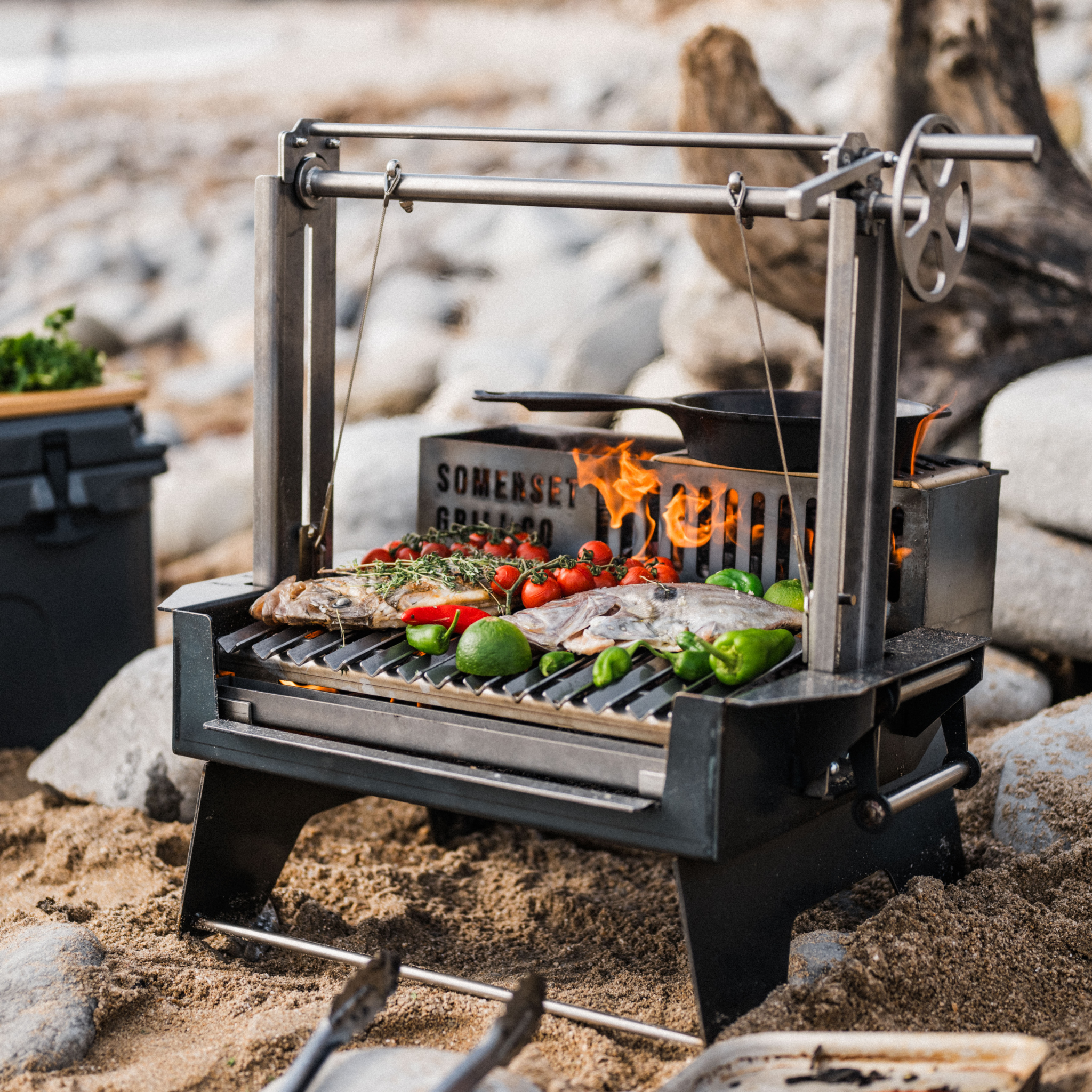

Most UK gardens have a BBQ in them somewhere. Fewer have an asado grill, though that is changing. Both cook outdoors and both pull people out of the kitchen, but they ask different things of you and give different things back.
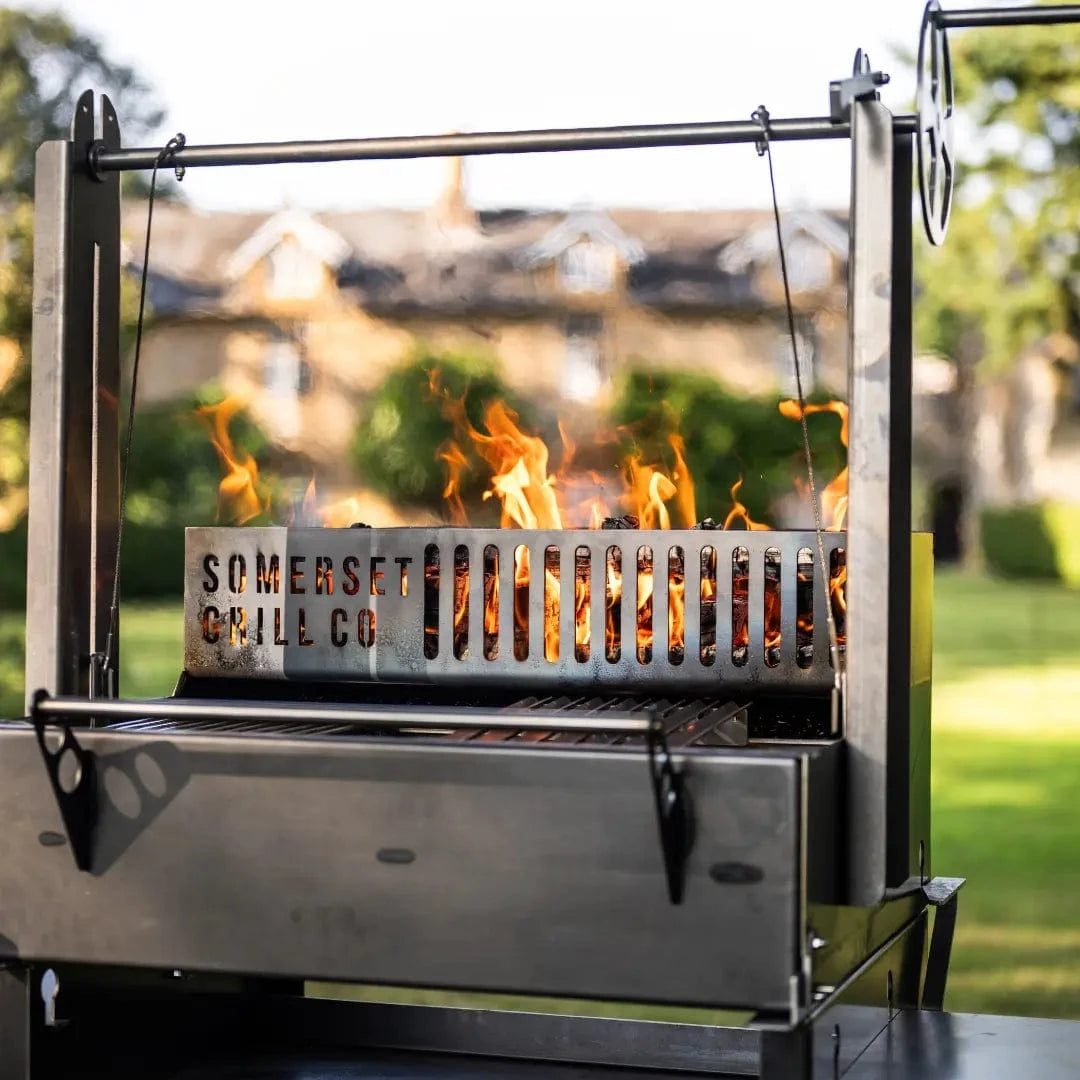
An asado grill cooks over glowing wood embers. You wind the cooking surface up or down to control temperature, anywhere from 40°C to 400°C. A traditional BBQ, gas or charcoal, cooks over direct flame with a knob or a fixed rack.
This guide compares the two on heat control, flavour, time, cost and the trade-offs of each, so you can work out which one fits the way you actually cook.
The Short Answer
An asado grill cooks over wood embers with an adjustable-height surface, so you can sear at 400°C or hold a joint at 40°C by turning a handle. A BBQ cooks over direct gas or charcoal flame, which is faster to light but harder to control. Asado grills suit longer, sociable cooks. BBQs suit quick weeknight meals.
What Is an Asado Grill?

Asado is the fire-cooking tradition of Argentina and much of South America. In the countryside it can mean whole animals on iron crosses beside an open fire. In towns and cities it usually means a parrilla: a grill with a cooking surface that winds up and down over the embers.
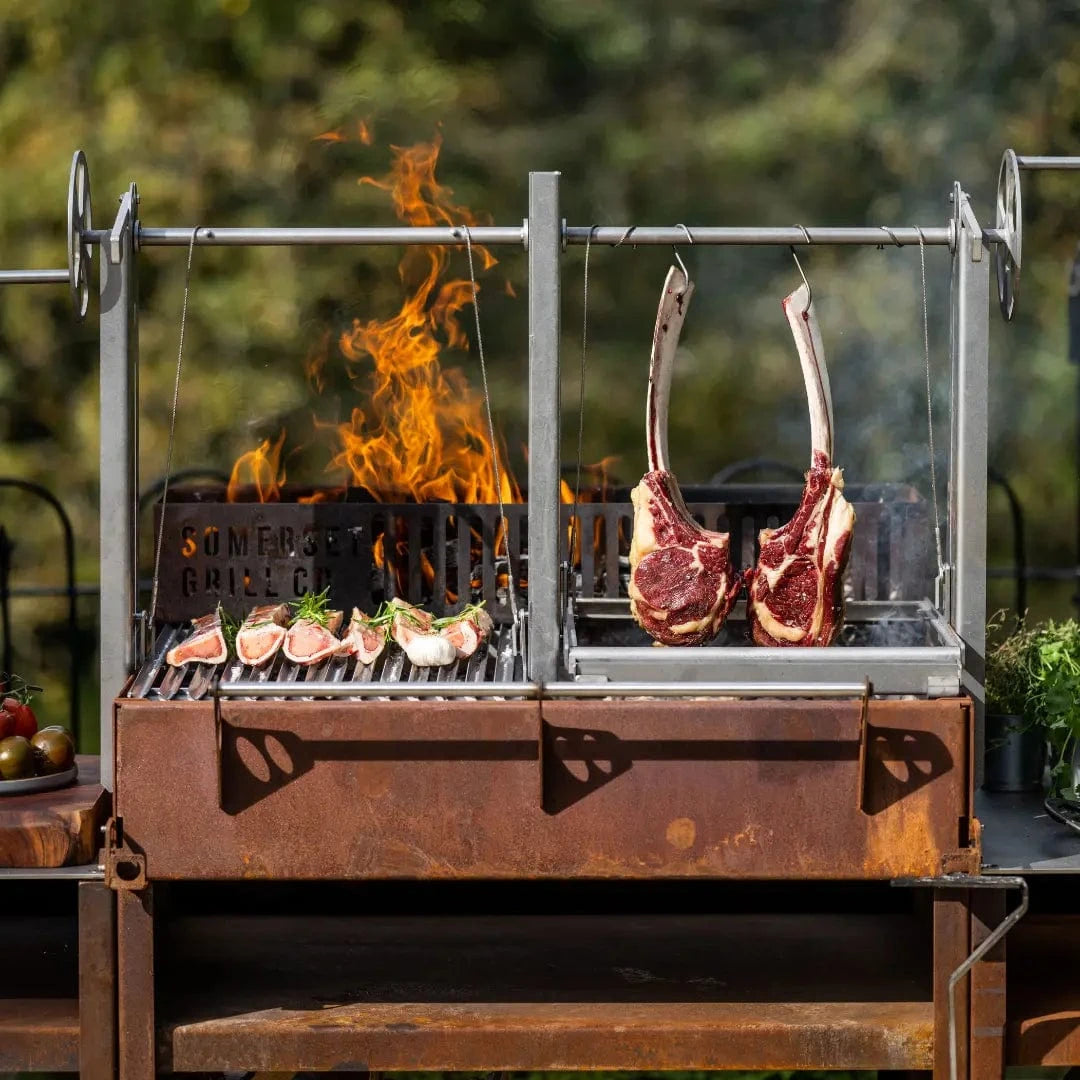
That height adjustment is the whole idea. Lower the grill and the food sears. Raise it and the heat softens, so a large joint can cook slowly without drying out. You are standing at the fire the entire time, moving the surface, feeding the embers, watching the fat drip and catch. Nothing happens under a lid.
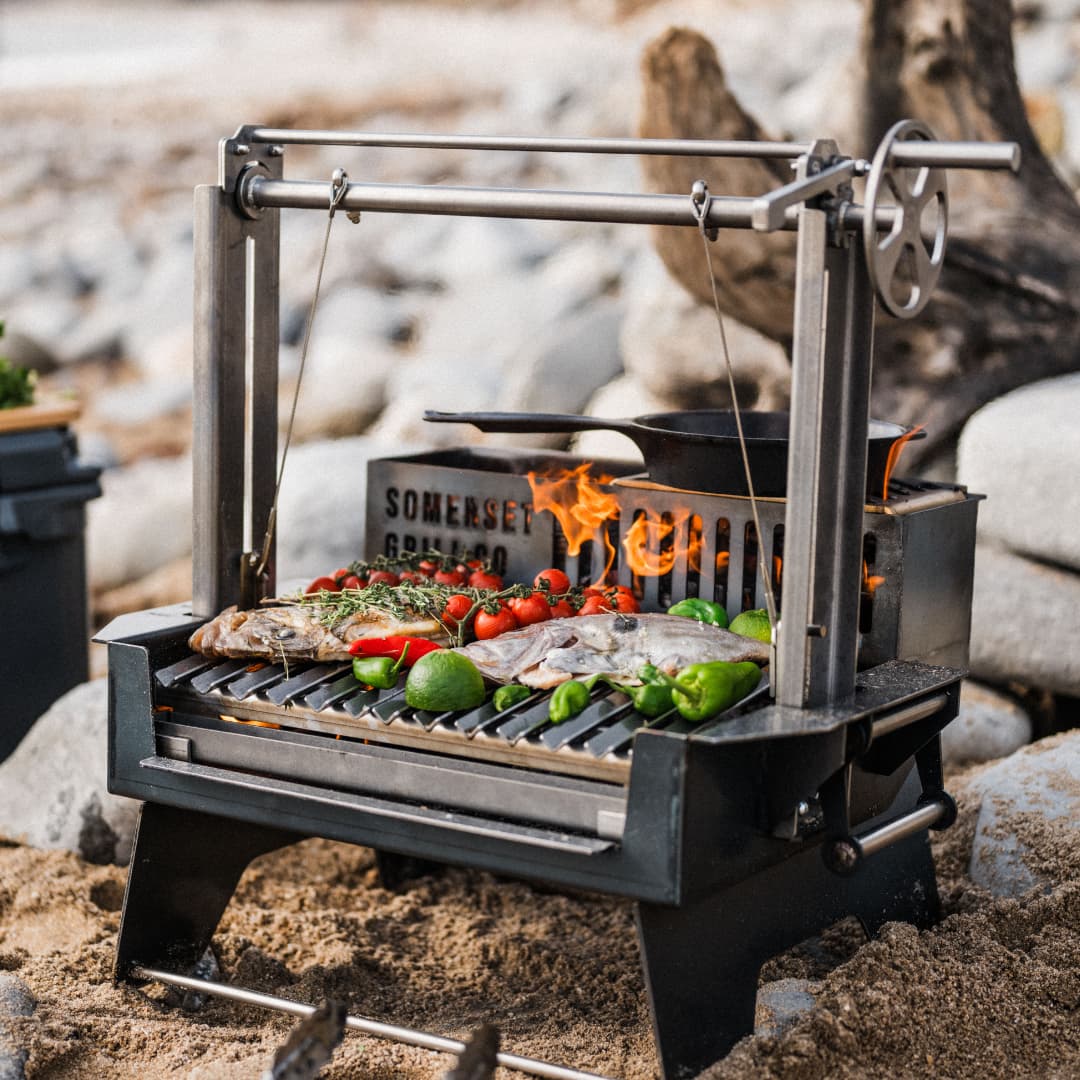
Traditionally it is about beef, and lots of it. But the same embers cook fish, chicken, lamb, vegetables in the ash, flatbreads, even puddings. For the history and the different styles, our guide What Is a Traditional Argentinian Grill? goes into more depth.
The food is half of it. The other half is the pace. Asado means people arriving before anything is ready, plates passed round as each cut comes off, and nobody checking the time.
What Counts as a Traditional BBQ?
The traditional BBQ is the UK's default for outdoor cooking, and it covers a wide range. A disposable foil tray for the beach costs a tenner. A six-burner gas grill with a side hob can run past £5,000. They are all built around the same idea: direct heat from a flame, food on a rack above it.
- Gas BBQs light instantly, heat evenly and clean up easily. The right tool for burgers and sausages when everyone is hungry now.
- Charcoal BBQs and kamados add real smoke and char. They need around 30 minutes to get going and more attention while cooking.
- Electric grills are essentially an oven element outdoors. Quick and tidy, with very little fire involved.
- Smokers are built for long, low cooks that can run overnight. Brilliant results, but they reward planning.
All of them are social in their own way. Most, though, are designed to get food cooked rather than to make the cooking part of the evening.
Key Differences Between Asado Grills and BBQs
| Feature | Asado grill | Traditional BBQ |
|---|---|---|
| Cooking style | Slow cooks and large joints over wood embers, with searing when you want it | Fast, direct heat from gas or charcoal |
| Heat control | Wind the grill surface up or down for 40°C to 400°C | Burner knobs on gas, moving racks and coals on charcoal, with a narrower range |
| Fuel | Kiln-dried hardwood logs, or good lumpwood charcoal | Gas or instant-light charcoal |
| Flavour | Deep smoke, rendered fat, a proper crust | Cleaner and simpler on gas, more smoke from charcoal or woodchips |
| Build | Heavy steel frame, stainless V Grills, drip tray, built-in ember maker | Lighter, mass-produced, fewer parts you can swap |
| Time | Build a bed of embers first, then hours of cooking if you want them | Minutes to heat, quick to cook |
| Social feel | People gather at the fire and graze as food comes off | Casual, shorter, usually eaten as one sitting |
| Looks | Open flame and glowing embers on display | Anything from painted steel to stainless boxes |
| UK price | £1,695 to £3,495 for a Somerset Grill, depending on size and finish | £100 to £5,000+ depending on fuel and size |
How You Control Heat, and Why Flare-Ups Stop

Heat control is where the two really part ways.
On a gas BBQ you turn a knob. On a charcoal BBQ you add or spread coals and, on some models, slide the rack to a different notch. Neither gives you much fine control over a big joint that needs to go slowly.
On an asado grill, you wind a handle. The grill surface rises or falls over the embers and the temperature follows. A few centimetres up takes the edge off. A few down and you are searing. After a few cooks you stop thinking about it and move the grill by feel.
Then there is the flare-up problem. On a flat rack, fat drips straight into the flame, flames leap up and the outside of your food turns to soot. The V Grills on our grills are stainless steel bars shaped as a V, sloped so fat runs along the channel and into a drip tray at the front instead of onto the fire. Flare-ups more or less disappear, and you get a tray of rendered fat to baste with.
We would use a meat thermometer on either. It takes the guesswork out of a big joint.
Why Embers Give Deeper Flavour
Cooking over a bed of embers changes how food tastes, and there is some science to it.
The Maillard reaction is what happens when the amino acids and sugars on the surface of food meet high, steady heat. It is the browning on a steak, the crust on a roast chicken. Beef is rich in the amino acids that drive it, which is why a steak over embers tastes the way it does.
An asado grill gives you that steady, radiant heat plus the smoke from real wood. Oak, apple and olive each leave a different note. And because you can hold a low temperature for a long time, you get tenderness alongside the crust rather than one or the other. More on this in our guide to choosing firewood.
Gas cannot do smoke without help. A charcoal BBQ gets closer, and woodchips in a smoker box close the gap further. But nothing we have cooked on matches meat that has spent two hours above a slow bed of oak embers.
Both will boil, simmer and fry. Both, if you are on charcoal, let you cook vegetables straight in the ash. An asado grill just gives you more room and more zones to do it in.
How Long It Takes
This is the honest one. A gas BBQ can have sausages on the table in fifteen minutes. An asado grill needs time to build embers before anything goes on, and a large joint can then take an hour or two.
If you want fast, buy the gas BBQ. No argument.
But if you are cooking for people rather than at them, the time is the point. The fire goes on mid-afternoon. Someone brings drinks out. Chorizo goes on first because it is quick, and gets eaten off the board while the lamb settles in. Smoke drifts across the garden. By the time the main joint comes off, everyone has been grazing for an hour.
BBQs tend to run the other way: food timed to land together, table laid, everyone sitting down at once. Both are good evenings. They are just different shapes.
The Trade-Offs Nobody Puts in the Brochure
An asado grill is not the right answer for everyone, and it is worth saying plainly.
- Lighting takes longer. You are building a bed of embers before anything cooks, every time.
- You need logs. Kiln-dried hardwood, kept dry. A Woodstore Stand underneath solves the storage, but it is still something you buy and keep topped up.
- It costs more up front.
- It is heavy. Ours arrive fully assembled and they stay where you put them.
- Gunmetal finishes need seasoning like a cast-iron pan. Cor-Ten does not, but it costs more.
Against that, an asado grill cooks year-round and gives you a way of cooking a BBQ simply cannot.
Equipment and Accessories
Both take accessories, and both get more useful with them.
A BBQ typically takes skewers, a smoker box, a wok holder and a griddle.
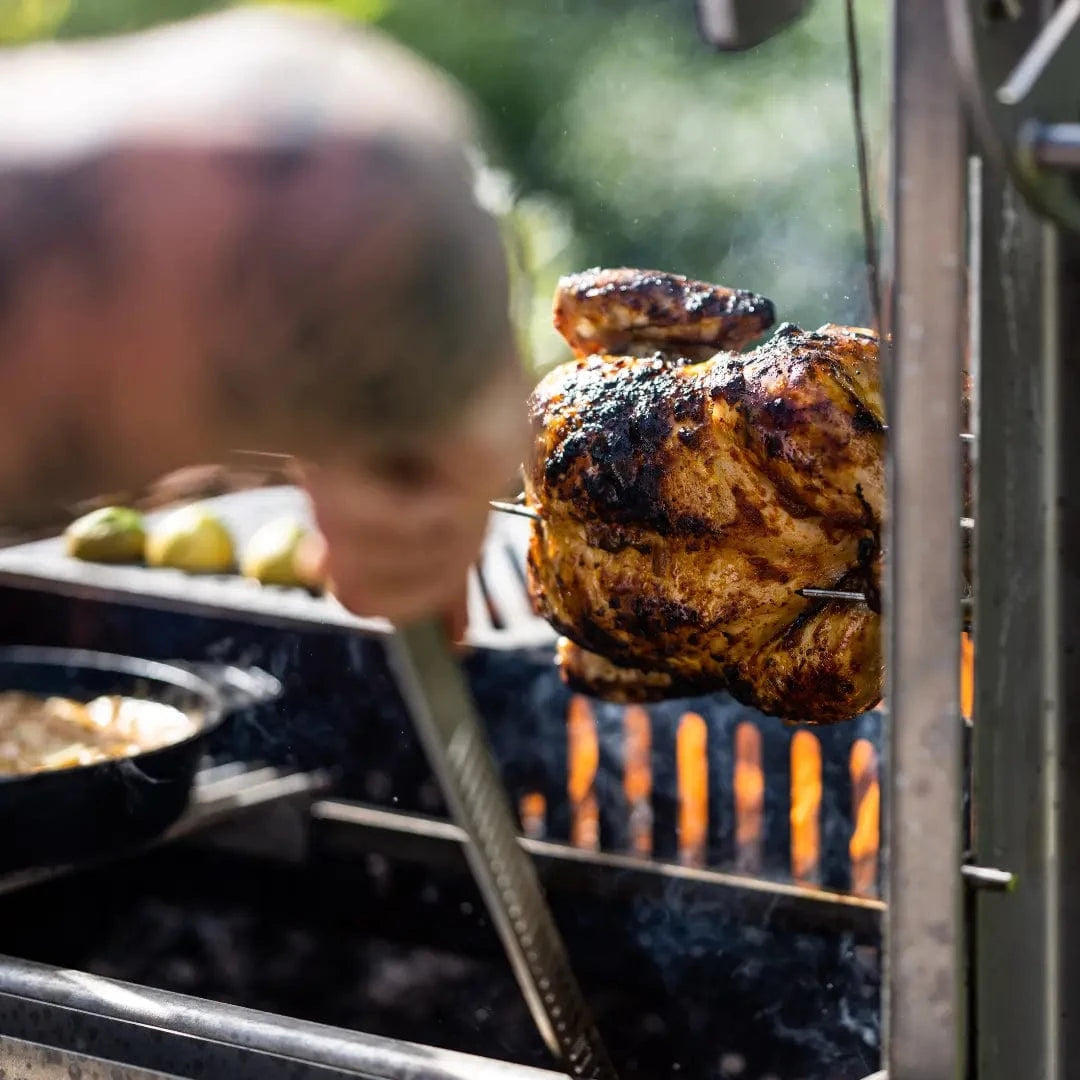
An asado grill takes all of those and goes further: a Rotisserie for chickens and porchetta, Meat Hooks for hanging joints in the smoke, a Chapa flat plate for smash burgers and breakfast, a Kebab Rack, Pizza Oven Plates, and an Ember Grill for cooking above the burning logs.

If you want the lot in one go, the Full Monty Accessories Bundle covers it.
How They Look in Your Garden
An asado grill is the kind of thing people stand next to. Open flame, glowing embers, logs stacked in the Woodstore Stand below. It works as the centre of an outdoor kitchen or on its own on a patio. The Cor-Ten finish weathers to a deep rust patina that suits a garden. Gunmetal goes darker with every cook.

BBQs vary. Some are neat stainless boxes. Some are bright painted drums that take up half the decking. The good ones look fine. Few of them make anyone want to pull a chair closer.
Which Grill Is Right for You?
A few questions worth answering before you buy either:
- How quickly do you want to eat?
- What do you want to cook? Burgers and sausages, or big joints, whole fish and vegetables in the embers?
- How many people, and how often?
- How much does flavour matter to you compared with convenience?
- What is your budget, both for the grill and the fuel?
If the answers are speed, simplicity and feeding a family on a Tuesday, a good gas BBQ is the right buy. It does that job well and we would never tell you otherwise.
If you already own a BBQ and find yourself wanting to cook more than it lets you, an asado grill is the next step. It is what we built ours for.
Our Verdict
For the way we like to cook, the asado grill wins. Not because a BBQ is bad, but because embers, height control and a slow afternoon at the fire give you something no knob-controlled flame can.
Somerset Grills take the principles of Argentinian grilling and make them work in a UK garden: a full-length ember maker for continuous fuel, stainless V Grills to stop flare-ups, and height control at the turn of a wheel. Delivered fully assembled, built in Somerset.
Explore the asado grill range, or visit the showroom and light one yourself.


Comments
0 comments